Redshift for Houdini: Out-of-Core, VRAM Limits and When It Beats Karma
You have cached a heavy Pyro or VDB scene in Houdini, but Redshift still runs out of GPU memory even with out-of-core enabled. Out-of-core can reduce VRAM pressure for supported data, but it does not remove every GPU memory limit. This becomes especially important with Houdini volumes, which can consume significant GPU memory. In this guide, we look at redshift houdini vram out of core, its limits, and when Redshift may be a better fit than Karma for a Houdini workflow.
Why does Redshift still run out of memory with out-of-core on?
Out-of-core does not eliminate Redshift’s need for VRAM. Some data can be handled outside GPU memory, but other render data still requires VRAM. Most importantly for Houdini simulation work, Redshift requires volume objects to fit entirely in GPU memory. If the required volume data exceeds available VRAM, rendering can stop with an out-of-VRAM error even when out-of-core is enabled.
System memory also matters when Redshift relies on out-of-core data, so having more RAM can help with supported workloads. However, adding system RAM does not solve a volume that itself cannot fit within the GPU memory available to Redshift.
What out-of-core handles and what it does not
Redshift’s out-of-core system is designed to let supported data, including textures and geometry, exceed available VRAM by using system memory when necessary. But not every part of a render can be handled this way.
Volumes are a key exception. Redshift states that volume objects must be stored entirely in GPU memory and are not handled by its out-of-core system. This means out-of-core should be viewed as a way to extend memory capacity for supported data, rather than as unlimited VRAM.
Out-of-core processing can also introduce a performance cost compared with keeping the required data in GPU memory, so enough VRAM remains valuable even for scenes that can render successfully with out-of-core.
The Houdini-specific problem: volumes from your sims
Houdini workflows frequently involve volume data from simulations. In USD workflows, SideFX documents volumes as collections of fields, including OpenVDB field assets for VDB data.
This matters with Redshift because its volume objects must fit entirely in GPU memory. Maxon specifically warns that having too many volume objects or volumes at particularly high resolutions can cause an out-of-VRAM error.
For heavy Pyro or other volume-based shots, reducing unnecessary volume data or resolution can therefore reduce GPU memory requirements. If the volume still exceeds available VRAM, a GPU with more memory may be necessary. Out-of-core alone cannot solve that particular limit.
When Redshift beats Karma for a Houdini shot
Redshift can make more sense when your production pipeline is already built around Redshift and you want to keep the same renderer and established look-development workflow for the Houdini shot.
However, Redshift should not be chosen simply because it is GPU accelerated. Karma XPU also uses GPU acceleration together with CPU resources, while Karma itself is deeply integrated with Houdini’s USD and Solaris environment.
That gives Karma a natural workflow advantage for projects already centered on Solaris, USD and MaterialX. SideFX documents Karma XPU support for MaterialX and USD Preview shaders, although XPU also has feature limitations compared with Karma CPU.
For texture-heavy scenes, Redshift’s out-of-core capabilities can still be useful. But whether Redshift actually renders a particular Houdini shot faster than Karma should be determined by testing the same scene on the same hardware with comparable settings, rather than assuming one renderer is universally faster.
When Karma is the better call
Karma can be the better choice when your Houdini pipeline is already centered on USD and Solaris. Karma is SideFX’s renderer designed for USD-based workflows in Solaris, making it a natural fit for projects already using this pipeline.
Licensing can also be a reason to stay with Karma. SideFX includes Karma rendering with Houdini licenses, while Redshift requires its own Maxon license.
For scenes that cannot fit within available GPU memory, Karma CPU provides a CPU-rendering alternative that does not depend on GPU VRAM. It still requires sufficient system memory for the scene, so this is an alternative memory path rather than a guarantee that every oversized scene will render.

Giving Redshift the machine it wants
For Redshift, more available VRAM gives the renderer more room for GPU-resident data, while sufficient system RAM supports CPU-side data and texture caching. This matters especially in Houdini volume workflows because Redshift requires volume objects to fit entirely in GPU memory, so out-of-core cannot compensate for a VDB that exceeds the available VRAM.
If your workstation hits this physical ceiling, moving the project to a dedicated Houdini render farm powered by an elastic Redshift render farm infrastructure provides the exact memory headroom your scene demands. That is where iRender becomes essential—giving pipeline TDs instant access to bare-metal nodes with 32GB RTX 5090 GPUs and 256GB system RAM, eliminating memory bottlenecks without rebuilding your established simulation workflow.
iRender - More VRAM and RAM for Redshift in Houdini
To tackle demanding production scenes, iRender offers dedicated Bare-Metal instances powered by next-generation NVIDIA GeForce RTX 5090 (32GB GDDR7 VRAM) paired with high-frequency AMD Ryzen™ Threadripper™ PRO processors and 256GB of high-speed system RAM. The jump to 32GB of VRAM provides crucial extra headroom for assets that must live entirely in GPU memory—such as dense OpenVDB explosion caches and complex Pyro simulations—substantially reducing out-of-core memory fallback penalties. Crucially, while deploying multi-RTX 5090 configurations accelerates render passes with near-linear compute scaling, GPU memory pools remain discrete; adding multiple cards does not merge their VRAM into a single pool. However, backed by AMD Threadripper’s massive PCIe lane bandwidth, heavy scene data and geometry caches are streamed to each GPU concurrently without data starvation.
With full administrator access to your remote node, you maintain total pipeline flexibility to install the exact Houdini builds, Redshift versions, and third-party plugins your project relies on. Redshift licensing remains bring-your-own-license (BYOL), and billing only runs while your instance is active—allowing technical directors to prep simulation caches before boot and engage auto-shutdown scripts as soon as final bucket rendering completes.
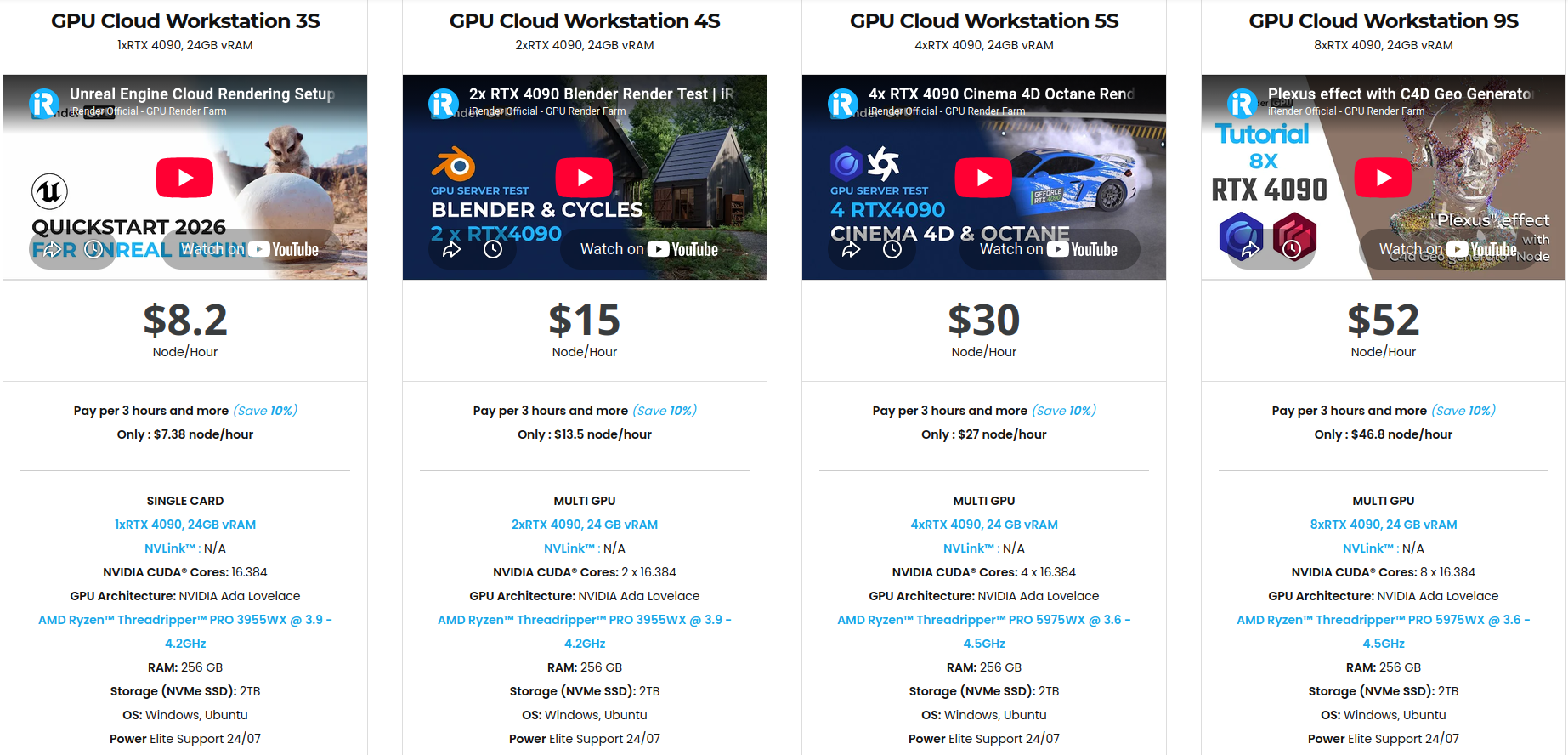
Available configurations include:
- CPU: AMD Ryzen™ Threadripper™ PRO 3955WX (3.9-4.2GHz) and AMD Ryzen™ Threadripper™ PRO 5975WX (3.6-4.5GHz)
- GPU: 1/2/4/6/8 RTX 4090/5090
For new users, iRender currently offers a 100% bonus on the first deposit within 24 hrs of registration, giving you additional rendering credits to get started with larger projects.
Maximum Speed – Absolute Freedom
Source: help.maxon.net, sidefx.com/docs/houdini/

Let’s see how our service works:

FAQ
1. Why does Redshift run out of memory in Houdini even with out-of-core enabled?
Redshift out-of-core can handle supported data such as textures and geometry, but it does not eliminate the need for VRAM. In particular, Redshift volume objects must fit entirely in GPU memory, so heavy Houdini volumes can still cause an out-of-VRAM error.
2. How much RAM does Redshift need for Houdini volumes?
There is no single RAM requirement for every Houdini scene. Memory usage depends on the scene and volume data. More system RAM can support Redshift’s out-of-core workloads, but it cannot replace the GPU memory required for volume objects.
3. Should I use Redshift or Karma for Houdini?
Redshift can make sense if your pipeline already uses Redshift and you want to keep its existing materials and rendering workflow. Karma is a natural choice for USD and Solaris-based workflows, while Karma CPU also provides an alternative when GPU VRAM is the constraint. Neither renderer is universally faster, so performance should be compared using the same scene and hardware.
Related Posts
The latest creative news from Houdini Cloud Rendering , 3D VFX Plugins & Cloud Rendering.