Karma CPU vs Karma XPU: Which One for Your Shot?
When working in Solaris, Houdini artists often face a key choice: Karma CPU or Karma XPU? Karma CPU offers broad compatibility and reliable rendering, while Karma XPU uses GPU acceleration for much faster performance on supported scenes. But faster does not always mean better.
In this article, iRender compares Karma CPU and Karma XPU to help you choose the right renderer for your shot based on speed, compatibility, shaders, and scene complexity.
Why does my material look wrong in Karma XPU?
“Hey guys, I have a quick question. I’m rendering a scene in Houdini. When I use Karma CPU, my materials look perfectly fine. But the moment I switch to Karma XPU to get a faster preview, some objects turn completely grey or completely lose their textures. Am I missing a setting or is my installation broken?” If this sounds familiar, don’t worry. Your Houdini installation is completely fine, and you didn’t click the wrong button. What you are experiencing is one of the most common traps for artists moving to SideFX’s modern rendering toolkit.
The truth is simple: Karma XPU does not support VEX-based shaders, and it will never support them. Because XPU runs on the GPU, it operates under a much more restrictive environment than the CPU. Older materials like the classic Principled Shader—rely heavily on VEX. When you switch to Karma XPU, the engine literally does not know how to read that data, so it drops the material and renders your object as a flat grey shape.
What Each Engine Is Actually Good At
Instead of viewing Karma XPU as a “better, faster” version of CPU, it is much more accurate to view them as two distinct tools designed for different scenarios.
Karma CPU
Karma CPU runs entirely on your processor. Because it doesn’t rely on graphics card limitations, it has total feature parity with everything Houdini can generate.
- Massive Memory Pool: It uses your regular system RAM. If your machine has 256GB of RAM, Karma CPU can handle massive, unoptimized scenes without breaking a sweat.
- Total Compatibility: It reads VEX, older shaders, complex material layering, and advanced geometric properties perfectly.

Karma XPU
Karma XPU utilizes both your CPU and GPU (mainly leveraging hardware like the RTX 4090) to give you near-instant feedback. It is incredible for look development, but it comes with strict boundaries.
- Strict Shader Diet: It is built from the ground up for MaterialX and USD-native workflows.
- VRAM Limits: Your scene geometry and textures must fit comfortably inside your graphics card’s memory (VRAM).

Pick by Shader First, Speed Second
When deciding which engine to use for a shot, your first check should always be your look development pipeline, not the render clock.
- Check for VEX: If your assets come from older projects or third-party libraries that rely on VEX or the traditional Principled Shader, your choice is already made for you. You need to use a Karma CPU unless you want to rebuild every material from scratch.
- Embrace MaterialX: If you are building a fresh scene using the Karma Material Builder node and sticking strictly to MaterialX nodes, Karma XPU will run beautifully.
Quick Tip: If you want to use XPU, always use the Karma Material Builder instead of older networks. SideFX specifically optimizes this node to work with XPU’s limited set of terminal nodes.
Then Pick by What the Shot Demands
Heavy Scenes (Volumes & Crowds)
If you are rendering massive things like giant cloud simulations or huge crowds that use more than 24GB of memory, your graphics card will run out of space. When the Karma XPU hits this memory limit, it can crash or become incredibly slow. In these situations, Karma CPU is your safe backup plan because your computer’s regular RAM is much bigger and can handle the heavy load.
Fast Tweaking (Lighting & Cameras)
If you are just moving lights around, changing camera angles, or testing simple materials, Karma XPU will save you a ton of time. It gives you instant, near real-time feedback so you can work fast without waiting for test renders.
Reading the Stats Instead of Guessing
Instead of guessing why a texture looks weird, let Houdini tell you the answer. Open your render log windows whenever you kick off a shot.
Karma XPU is very vocal in its logs. If it encounters a material node it doesn’t support, it will print a direct warning stating that the node cannot be compiled for the GPU and will be skipped. Reading these logs for two seconds will save you hours of random troubleshooting.
Choosing Your Engine at a Glance
| Your Scene Scenario | Recommended Engine | Why? |
| Scene contains legacy VEX shaders | Karma CPU | XPU will never support VEX architecture. |
| Built entirely with MaterialX | Karma XPU | This is the exact workflow XPU is built for. |
| Using traditional Principled Shaders | Karma CPU | XPU does not support it; it only creates a misleading preview. |
| Scene size exceeds your GPU’s VRAM | Karma CPU | CPU utilizes massive system RAM instead of crashing. |
| Rapid look dev and lighting tweaks | Karma XPU | Leverages GPU power for instant visual feedback. |
| Highly complex, custom material layering | Karma CPU | XPU has strict limits on arbitrary material blending. |
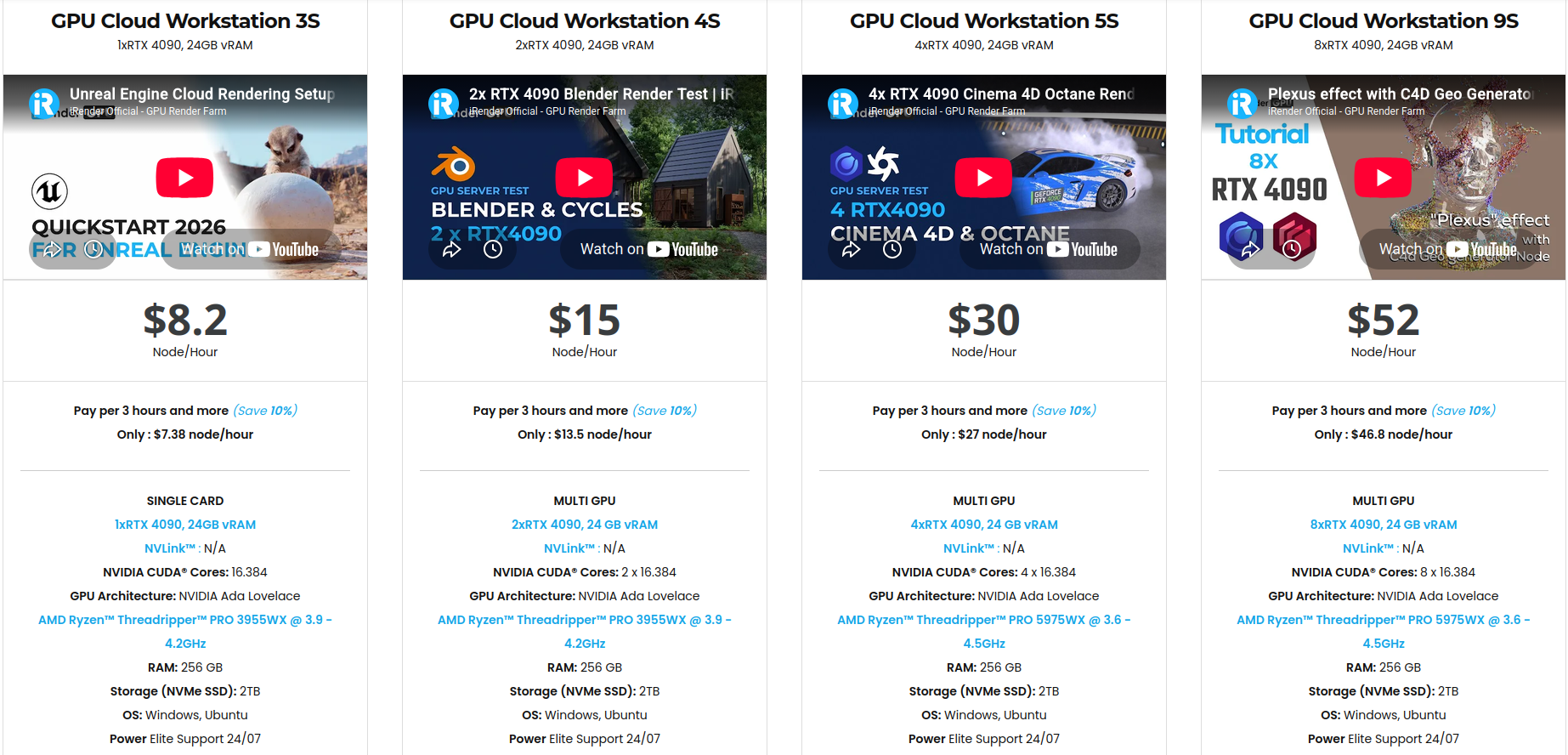
Configuring iRender for Karma CPU vs. XPU Demands
When you take your project to a cloud solution like iRender, understanding this CPU vs. XPU distinction changes how you configure your hardware. Because iRender provides an IaaS (Infrastructure as a Service) model, you get full remote access to a clean, powerful Windows or Linux machine. You install your specific version of Houdini and run it exactly like your local computer, making it the absolute best ecosystem for both Karma CPU and XPU workflows.
- If you choose Karma CPU: Your main bottleneck is processing cores and system memory. iRender is the perfect match here, offering beastly servers equipped with AMD Threadripper Pro processors and up to 256GB of RAM. This massive memory pool ensures your giant VEX networks and heavy geometry render smoothly without ever hitting a memory error.
- If you choose Karma XPU: You need raw graphics power and massive VRAM. iRender excels as a GPU powerhouse, allowing you to provision servers with up to 8x RTX 4090 GPUs (24GB VRAM each). Even better, if you want to push the absolute limits of XPU speed, you can upgrade your setup to their latest RTX 5090 line, giving you next-generation architecture, massive VRAM( 32GB), and unmatched processing speeds to blast through your MaterialX frames.
Whether you need a heavy CPU workhorse or a multi-GPU speed demon, iRender gives you the exact hardware flexibility your Houdini shot demands.
Let’s see the configuration below:
Register today to take advantage of a 100% bonus on your very first deposit!
Let’s watch the tutorial video to see how our service works:

FAQ
- Why does Karma XPU render my material as grey?
This usually happens because the material uses a shader type unsupported by Karma XPU, most commonly VEX-based shaders or older Principled Shaders. SideFX documentation explicitly states that XPU will never support VEX shaders. Check your render logs to identify which materials are being skipped, then convert them to MaterialX or switch to Karma CPU.
2. Is Karma XPU always faster than Karma CPU?
Not in every situation. While XPU leverages your GPU to deliver faster interactive feedback during look development, it requires shader compilation at startup and is strictly limited by available VRAM. For scenes that exceed VRAM limits or rely heavily on shaders that XPU cannot process, Karma CPU is both safer and often the more practical choice.
3. Should I switch my Houdini scenes to MaterialX?
If you plan to use Karma XPU, yes—XPU is designed specifically around MaterialX and native USD materials. SideFX recommends using the Karma Material Builder along with its included shaders. However, if you are maintaining legacy projects built entirely on VEX shaders, keeping them on Karma CPU is much less effort than converting every material manually.
Maximum Speed – Absolute Freedom
Related Posts
The latest creative news from Houdini Cloud Rendering , 3D VFX Plugins & Cloud Rendering.