D5 Render on RTX 5090: Settings, DLSS 4 and Real Performance Gains
NVIDIA says D5 Render runs up to four times faster on an RTX 5090. Scroll through the D5 Render forum and you will find users reporting a much smaller jump, sometimes barely ahead of an RTX 4090 at all. They are measuring two completely different things, and the gap between those two numbers is the whole story of what RTX 5090 actually changes in D5.
DLSS 4 and RTX 5090 make it sharper than usual, because for the first time the viewport gain really is dramatic. Here is what changed, where it changed, and how to set D5 up to actually use the 32GB on this card instead of leaving it on the table.
How much faster is D5 Render on an RTX 5090?

Image Source: D5 render
In the viewport, noticeably faster, once DLSS 4 Multi Frame Generation is switched on. NVIDIA’s own figure for D5 is up to a four fold increase in frame rate, and that number is specifically about navigating the scene, not about how long a final image takes to export. For export time, expect something closer to a normal generational bump. 32GB of VRAM is the part that pays off quietly: scenes loaded with dense scattered vegetation or large point clouds that used to choke a 24GB card now have real headroom before they start dropping texture quality or crashing mid export.
Two kinds of speed in D5, and why people get confused
D5 asks two very different things of a GPU. One is keeping the viewport responsive while you orbit a camera, drag a material onto a surface, or scrub a timeline. The other is actually computing the final pixels for an export, whether that is a still image, a panorama, or a video. DLSS 4 Multi Frame Generation only touches the first one.
MFG works by generating extra frames between the frames your GPU actually traces, using an AI model rather than computing new rays for each one. That is a genuinely good trick for making a scene feel fluid while you work, since navigation speed is measured in frames per second, and a generated frame counts toward that number the same as a traced one does. A final export is not measured that way. It is about how long it takes to trace, sample, and resolve a single image (or a full sequence of them) at full quality, and MFG does not insert generated frames into that calculation.
On the D5 Render forum: does the FPS boost NVIDIA is advertising also shrink render time, or is it purely a viewport thing? The general read from people who already had their cards in hand was that render time improved by something closer to a normal generational jump rather than anything near 4x.
A handful of early RTX 5090 owners reported the card sitting at unusually low utilization, in some cases close to 10 percent, particularly with scatter objects like grass or foliage enabled, with GPU usage cycling between short bursts of activity and idle gaps rather than running flat out.
Setting up D5 to use DLSS 4 on an RTX 5090
Four steps, in order, before you touch an export button.
- Update your NVIDIA driver to the current Studio driver, not whatever Game Ready driver installed itself by default. Early Blackwell drivers had a rockier reputation with creative apps than with games, and a current Studio driver is the first thing to check if DLSS options look greyed out or missing entirely.
- Update D5 Render itself to a build that lists DLSS 4 support in its changelog. Multi Frame Generation will not appear in the display settings on an older version even with the right card and driver already installed.
- Open the display or rendering settings panel and turn DLSS on, then set frame generation to the multiplier you want.
- Turn on an FPS overlay, either D5’s own or an external one like the NVIDIA app overlay, so you can see the real number change as you toggle settings rather than judging by feel.
One note is with frame generation on, fast moving elements like swaying foliage or shifting shadows can show a bit of smear or ghosting, because the AI model is guessing at in-between frames rather than tracing them. For a live walkthrough that is barely noticeable. For a still screenshot grabbed mid motion, turn frame generation off first and re-capture.
D5 quality settings that actually use 32GB

Image Source: D5 render
With extra 8GB over RTX 4090 only matters if your settings are actually asking for it. A scene running at default quality on a 24GB card will not suddenly look different on a 32GB one. Where the headroom shows up is in a handful of specific settings:
- Export resolution at 4K or 8K rather than 1080p or 2K, since resolution is one of the biggest VRAM multipliers in any real time renderer
- Sample count and quality tier for global illumination and reflections
- Scatter density for grass, trees, and other instanced vegetation.
- High resolution textures, particularly on large environment scenes carrying multiple 4K or 8K material sets at once
A rough starting point for three common deliverables:
- Still images: push GI and reflection quality to the top tier, keep scatter density at whatever the scene genuinely needs rather than maxing it out for its own sake, export at 4K or 8K
- 360 panoramas: these run heavier than a standard still at matching settings because D5 is resolving a full sphere rather than one camera frustum, so watch VRAM closely if the scene also carries dense scatter
- 4K video: this is where long export queues and VRAM spikes most often cause crashes.
Common D5 problems on RTX 50 cards
A few issues have come up often enough around RTX 50 launch that it is worth having an answer ready before they hit you mid deadline.
App crashes on launch, or the viewport goes black right after a driver update. Roll back to the previous known-good Studio driver first and confirm D5 opens normally, then update one version at a time rather than jumping straight to the newest release.
Card is not recognized, or D5 falls back to software rendering. This almost always traces back to a D5 build that shipped before RTX 50 support landed. Update D5 first, then recheck Device Manager to confirm Windows sees the card correctly before touching anything else.
Running out of VRAM partway through a long video export. Drop scatter density or texture resolution for that specific export, or split a long sequence into shorter segments rendered one after another. Peak VRAM during video export tends to spike well above what a single still frame from the same scene uses.
Viewport stutters even though the GPU looks underused. D5’s real time viewport leans on single-core CPU performance for draw calls as much as it leans on the GPU, so a strong card paired with a weak or overloaded CPU can still stutter.
Running D5 on a cloud RTX 5090
At iRender, you rent a Windows machine built around a single RTX 5090 (32GB GDDR7), the GPU Cloud Workstation 3i configuration, paired with an AMD Threadripper PRO 3955WX and 256GB of RAM, at 10.8$ per hour (9.72 $from three hours onward). You install D5 on it the same way you would on your own PC, sign in with your own D5 account, and work on it through remote desktop exactly as if it were sitting under your desk. Hand the export off to that machine and keep modeling or adjusting materials on your own computer while it renders.
D5 is a real time application you open and interact with, not a scene file you hand off and wait on. Services built around uploading a project and getting frames back have nowhere to run D5 at all, because there is no desktop for you to sit in front of.
Here is the configuration of server 3i, you can refer:
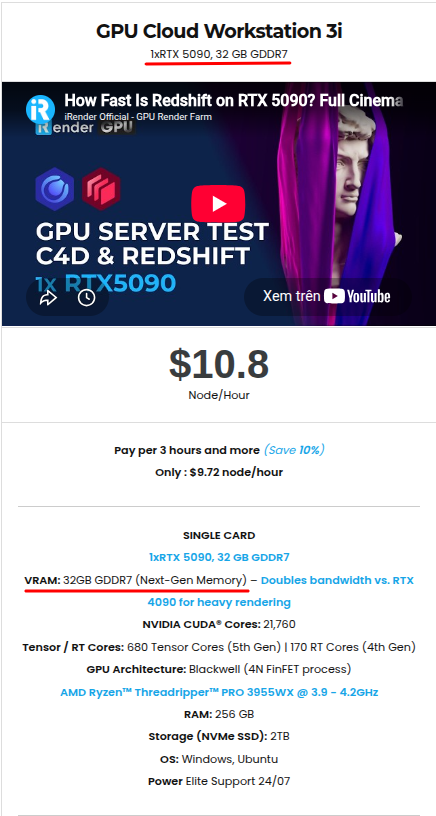
Not only those powerful configuration, iRender also provides you more services. Free transferring tool named iRender drive for macOS or Linux users. For Windows users, we recommend using our all-in-one application iRender GPU to work, and you don’t need to come to our website. Our price is flexible with hourly rental which has pay-as-you-go basis, from 3 hours subscription with discount 10%. Plus, you have support service with real human who will support you when encountering any issue.
You can check how to run D5 render on our server via quick video:

With the price of $10.2 for 3i server (1 hour rental minimum), now you can experience the newest card and enjoy working smoothly in a customized pipeline like you have always done with your own PC.
Don’t hesitate to register right now to render on our new server 1x RTX5090. You just need to update the latest NVIDIA studio driver to get the best out of it.
We are offering the promotion for new users. For your first transaction within 24 hours since your registration, you will receive a 100% bonus. Contact us via Whatsapp +(84) 916017116 for more support.
Maximum Speed – Absolute Freedom
FAQ
Q1: Does D5 Render support DLSS 4 Multi Frame Generation?
Yes. D5 Render was on NVIDIA’s day-one list of apps supporting DLSS 4, alongside titles like Cyberpunk 2077 and Alan Wake 2. Multi Frame Generation needs an RTX 50 series card and only affects viewport frame rate while you navigate a scene. It does not shorten final export time by the same ratio, since export is a different calculation that MFG was never built to speed up.
Q2: Is the RTX 5090 much faster than the RTX 4090 in D5 Render?
In the viewport with DLSS 4 switched on, yes, noticeably. For actual export time, users on the D5 Render forum generally report a more modest gain, closer to what you would expect from one GPU generation to the next rather than anything close to the 4x figure NVIDIA quotes for frame rate. The real number varies with your scene, your settings, and which quality tier you export at, so testing your own file is worth more than any number quoted here.
Q3: Can I run D5 Render on a Mac?
No official Mac build exists. Mac users who need D5 generally run it on a Windows machine with an RTX 5090 rented in the cloud, connecting over remote desktop, rather than waiting on native support.