Is Your 3D Project Safe on a Render Farm? Data Security and NDAs
A client may ask, “My project is covered by an NDA and I cannot send the files outside my company. Can I still use a render farm?” The answer starts with two separate checks: how the provider protects your data and what your own NDA allows.
Render farm data security NDA 3D project decisions should be checked against both the provider’s policies and your client agreement.
This article provides a framework for evaluating both sides rather than declaring that any service is automatically safe or permitted.
Two different questions people tend to merge
When security comes up, I often see two questions treated as if they were the same. They are not. The first asks how a render farm protects the project data it receives, while the second asks whether your client agreement allows you to send that data to a third party in the first place.
The first question is mainly technical and contractual. You can ask the render farm about its security measures, data handling rules, access controls, storage practices, and NDA options. Its published terms can also show what responsibilities and protections apply when you use the service.
The second question belongs to the agreement between you and your client. Your NDA may restrict third-party access, require prior notice, or require written approval before subcontractors or external services can handle confidential material. Only you and your client know the exact obligations in that agreement, so a render farm cannot determine whether your particular NDA permits the workflow.
You need both answers before deciding how to handle the project. The first tells you what level of protection a provider claims to offer, while the second tells you whether you are allowed to place the client’s data there at all. For a render farm data security NDA 3D project workflow, I would treat these as separate checkpoints and document what you find. This article cannot interpret your NDA for you because the agreement is between you and your client, with the render farm acting as a third party.
Read your NDA before you read any provider page
Before comparing render farm security pages, read the NDA you signed with your client. Look specifically for clauses covering subcontractors, third-party service providers, cloud services, data transfers, or access to confidential information. Some agreements may require notification or written approval before another company can handle project files.
If your NDA requires notice or approval, clarify the situation with your client before uploading anything. A lawyer can also help when the wording is unclear or the project has significant contractual restrictions. Avoid relying on your own interpretation of a legal clause, because a small misunderstanding can create problems later.
The questions to ask any provider
If your client agreement allows you to use a render farm, the next step is to evaluate the provider itself. Ask how it handles project data, who can access it, where it is stored, and how it is removed. These details help you judge whether the provider’s security practices match the needs of your render farm data security NDA 3D project workflow.
-
-
-
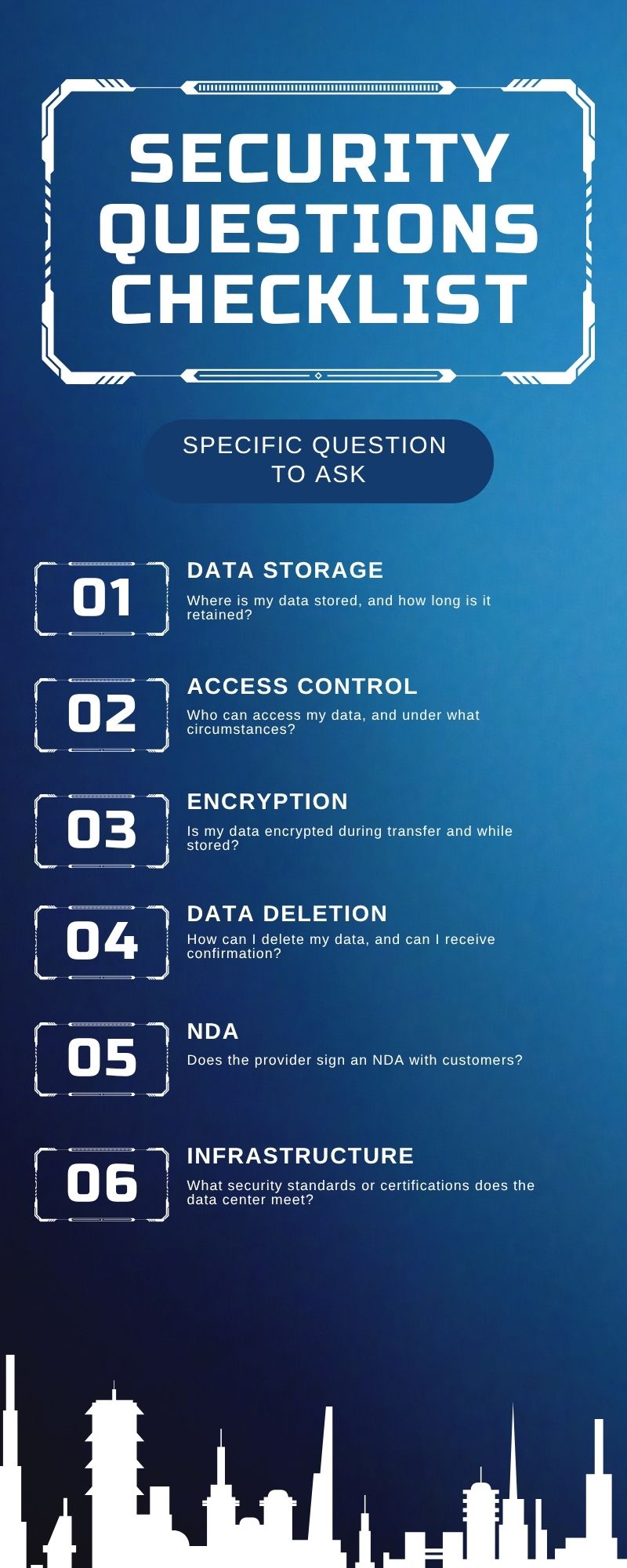
- Data storage: Where is my project data stored, and how long is it kept?
- Access control: Who can access my data, and under what circumstances?
- Encryption: Is my data encrypted both during transfer and while stored?
- Data deletion: How can I delete my files, and can I receive confirmation that they were removed?
- NDA: Does the provider sign an NDA with customers?
- Infrastructure: What security standards or certifications does the data center meet?
-
-
Use the checklist below to structure the conversation and identify areas that need clearer answers.
Security questions checklist for any render farm provider
| Category | Specific Question to ask | Potential warning sign |
|---|---|---|
| Data Storage | Where is my data stored, and how long is it retained? | Vague answer with no clear retention period |
| Access Control | Who can access my data, and under what circumstances? | No clear access procedure |
| Encryption | Is my data encrypted during transfer and while stored? | The provider avoids giving a clear answer |
| Data Deletion | How can I delete my data, and can I receive confirmation? | No way to request or verify deletion |
| NDA | Does the provider sign an NDA with customers? | Refusal without a clear explanation |
| Infrastructure | What security standards or certifications does the data center meet? | Cites standards that do not meaningfully address information security |
Why the service model matters here
The service model can affect how much direct control you have over your project data during the rendering process.
With a dedicated cloud workstation model such as iRender, you work directly on a rented machine and decide which files to upload and when to remove them. With a submission-based render farm, your scene may instead pass through the provider’s automated processing pipeline, so some parts of data handling may happen outside your direct control.
This is a difference in how the services operate, not a judgment about which model is more trustworthy. I would still ask each provider specific questions about storage, access, encryption, deletion, and infrastructure. The checklist above gives you a practical way to compare the answers and identify anything that needs clarification.
What you can do on your side
When I work with a render farm provider, I also look at the steps I can control myself. Good provider security does not remove the need for basic project hygiene, especially when the files contain confidential client material.
-
-
-
-
- Upload only what you need: Send only the assets required for the render.
- Delete finished data: Remove project files from the remote machine when the work is complete.
- Reduce project identifiers: Avoid putting client names, project codes, or other sensitive details in file and folder names.
- Secure your account: Use a strong password and multi-factor authentication when available.
-
-
-
Getting it in writing
For projects with strict confidentiality requirements, written commitments are more useful than assumptions based on a provider’s website. If you are allowed to use a render farm, ask the provider to confirm the relevant security measures and data-handling terms in writing.
Ask specific questions and request specific answers. The checklist questions can help you structure that conversation and keep a record of what the provider has actually committed to.
iRender: Speed up your workflow with the RTX 5090 cloud workstation
iRender operates as an IaaS cloud workstation service, where users rent dedicated machines rather than submitting scenes through a conventional automated rendering pipeline. This model gives you direct control over which project files reach the workstation and when they are removed. Ours infrastructure uses Tier III data centers and lists ISO/IEC 27001 among the information security standards.
For data transfer, iRender ensures that communication between your device and the cloud workstation is protected with SSL encryption, while account registration includes a verification process. We also make sure that temporary files and cached data are automatically removed when a rented server is shut down.
Your project files remain private throughout your time on iRender. Files and rendered outputs are stored on secure internal servers that are protected from unauthorized external access. iRender does not share your personal information or project data with any third party unless you provide written permission.
We provide an NDA document that can be reviewed before deciding whether its terms fit a particular project. You can check our NDA here for more information.
Your NDA with your client remains your responsibility. Choosing a render farm does not change the obligations you accepted in that agreement.
Right now, iRender is launching the 100% bonus for new user’s first deposit, check it out.
Check out some of iRender tests on RTX 5090 and 4090:


FAQ
Q: Is it safe to upload client work to a render farm?
There are two separate questions to answer. First, how does the provider store and protect your data? Ask about storage, access controls, encryption, and deletion. Second, does your NDA allow you to share client data with a third party? That question depends on your agreement with the client, not the provider’s security measures.
Q: Does my NDA allow me to use a render farm?
You need to read your own NDA carefully. Some agreements include specific rules for subcontractors or third-party services, and they may require prior notice or written approval. If the wording is unclear, ask your client or a legal professional for clarification. Do not rely on your own assumption when the contractual risk remains with you.
Q: What does a Tier 3 data center actually guarantee?
A Tier III classification focuses on data center infrastructure, availability, and redundancy. It is not, by itself, a certification of information security. A Tier III facility may offer strong operational resilience, but that does not prove how your project files are protected. Ask separately about storage, access, encryption, and data deletion.
Register an account on iRender to claim your 100% bonus for the first deposit and render without limitations.
iRender – Maximum Speed – Absolute Freedom.