Recommend best GPUs for Stable Diffusion in 2025 with iRender
As the field of artificial intelligence continues to develop, tools like Stable Diffusion have gained popularity for generating high-quality images. This powerful generative model relies heavily on graphics processing units (GPUs) to perform its complex calculations efficiently. In 2025, the GPU landscape is rich with options, making it essential for users from hobbyists to professionals to choose the right hardware to optimize their experience with Stable Diffusion. With advancements in technology, GPUs now offer increased performance, enhanced memory capacities, and improved power efficiency.
This blog will recommend the best GPUs for Stable Diffusion in 2025. Let’s get started with iRender!
What's new in Stable Diffusion in 2025?
Stable Diffusion is an advanced generative model designed for creating high-quality images from descriptive text inputs. It is part of the family of diffusion models, which are a class of deep learning algorithms used in various applications, including image synthesis, super-resolution, and inpainting. Originally developed by researchers in the field of artificial intelligence, Stable Diffusion has gained significant attention for its ability to produce visually compelling images with remarkable detail and coherence.
Key features of Stable Diffusion in 2025
Text-to-Image Generation
Text-to-image generation is a fascinating area within artificial intelligence (AI) that involves creating images from textual descriptions. This technology leverages deep learning models, such as those based on GANs (Generative Adversarial Networks), VAEs (Variational Autoencoders), and diffusion models, like Stable Diffusion.
Image-to-Image Generation
This allows users to provide an initial image along with a text prompt to guide the generation of a new image. Image-to-image generation in Stable Diffusion represents a significant step forward in creative AI applications. It combines the strengths of diffusion models with user interactivity and rich prompt capabilities, paving the way for innovative artistic and commercial applications. As developments continue, we can expect even more intuitive and powerful tools for users in various fields.
Customization & Fine-Tuning
Customization and fine-tuning in Stable Diffusion allow users to tailor the model to meet specific needs, enhancing its usability for individual projects or particular styles.

Why is Stable Diffusion important?
Stable Diffusion is important because it democratizes access to powerful image generation technology, allowing individuals and organizations to create high-quality visuals from simple text prompts. Unlike older, centralized AI models, Stable Diffusion is open-source, allowing it to be freely used, modified, and integrated into diverse applications—from art and design to marketing and game development. Its ability to run on consumer-grade hardware also sets it apart from more resource-intensive models, making it accessible to independent creators and small businesses.
Moreover, Stable Diffusion enables unprecedented creative freedom by allowing users to fine-tune models, train them on custom data, or blend different art styles—all of which fuel innovation across industries. In short, Stable Diffusion represents a major shift in AI-powered creativity, offering scalable, customizable, and cost-effective tools to a broad community of users.
Best GPUs for Stable Diffusion in 2025
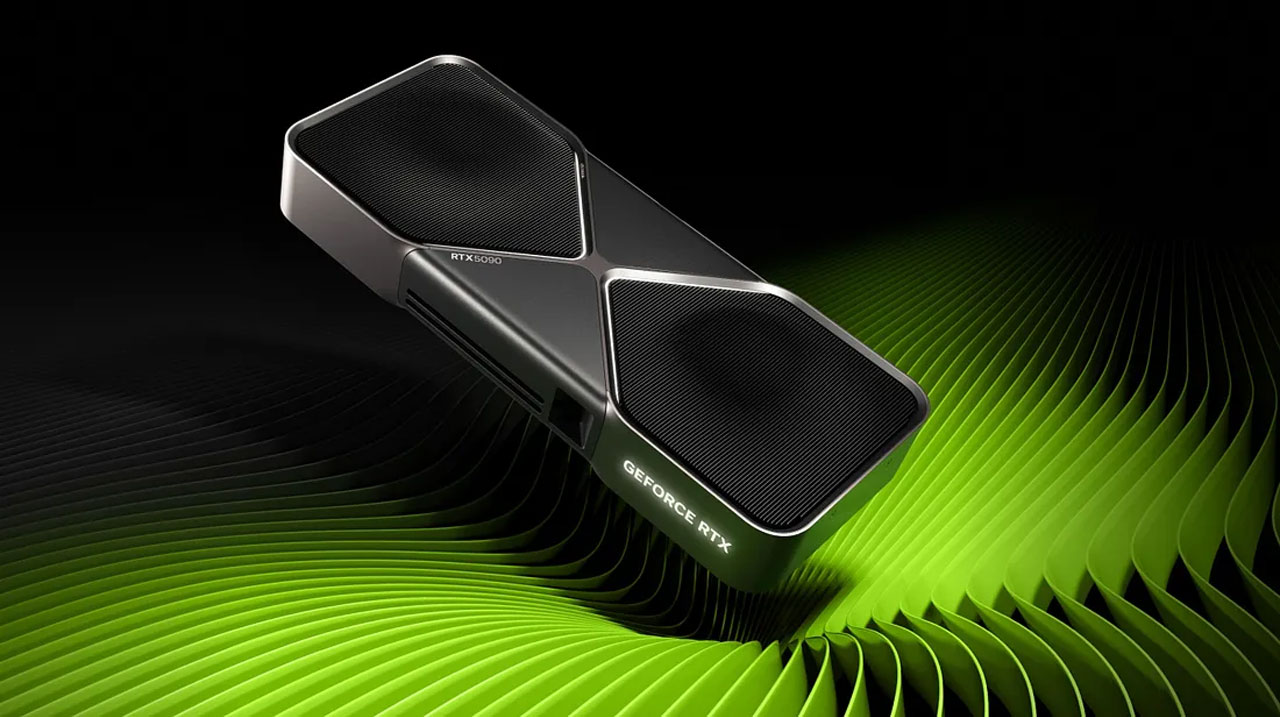
NVIDIA GeForce RTX 4090 & RTX 5090
NVIDIA GeForce RTX 4090 is a powerhouse in the gaming and AI space, utilizing the Ada Lovelace architecture to deliver exceptional performance and efficiency. It features a staggering 24 GB of GDDR6X VRAM, making it ideal for demanding tasks such as real-time ray tracing and high-resolution image generation with models like Stable Diffusion. With its 16,384 CUDA cores, the RTX 4090 excels in parallel processing, significantly speeding up deep learning and rendering workloads.
RTX 5090 is the most powerful GeForce GPU ever made, bringing game-changing capabilities to gamers and creators. Tackle the most advanced models and most challenging creative workloads with unprecedented AI horsepower. As machine learning and graphics demands rise, the RTX 5090 is likely to redefine performance benchmarks, making it an exciting prospect for gamers and professionals alike, particularly in fields like image synthesis and AI-driven design. Both GPUs stand at the forefront of technology, catering to the needs of users who prioritize power and cutting-edge features.
NVIDIA GeForce RTX 4080
The NVIDIA GeForce RTX 4080 with 16 GB of GDDR6X VRAM is an excellent choice for running Stable Diffusion and other deep learning applications. Built on the Ada Lovelace architecture, the RTX 4080 brings significant improvements in performance and efficiency compared to previous generations.
The 16 GB of VRAM is more than adequate for handling the memory requirements of Stable Diffusion, allowing users to generate high-resolution images and process complex models without running into memory limitations.
With high CUDA core counts, the RTX 4080 excels in parallel processing, which is crucial for the iterative computations involved in generating images. This results in faster rendering times and smoother performance for artistic and creative tasks.

NVIDIA GeForce RTX 3090
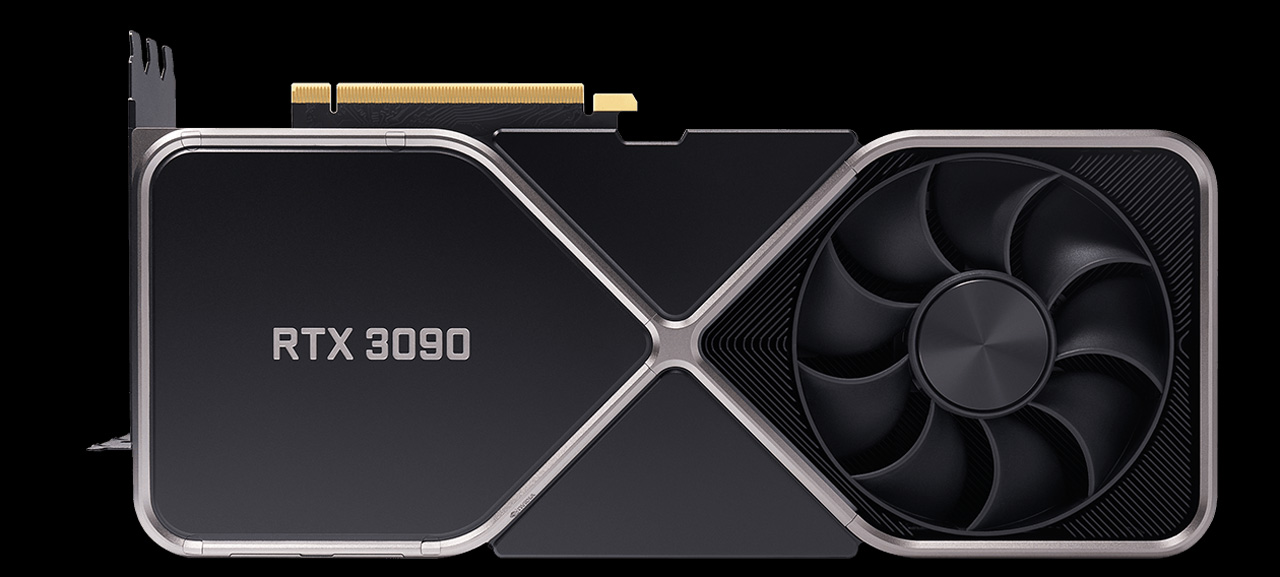
The NVIDIA GeForce RTX 3090 is a robust option for running Stable Diffusion, particularly favored for its high performance in AI and creative applications. The RTX 3090 boasts 24 GB of GDDR6X memory, which is particularly beneficial for handling large neural networks and high-resolution image generation in Stable Diffusion. With 10,496 CUDA cores, the RTX 3090 excels in parallel processing, enabling faster computations needed for rendering images and training AI models. This results in reduced generation times, allowing for quicker iterations and experimentation.
NVIDIA GeForce RTX 4060 Ti
If you’re just dipping your toes into the world of AI-driven image generation, the NVIDIA GeForce RTX 4060 Ti 16GB is an excellent starting point. Priced reasonably and offering robust performance, it strikes the perfect balance between affordability and capability.
While it may have limitations concerning training larger models or handling ultra-high-resolution outputs, it provides an excellent balance of performance and efficiency for a variety of AI applications.
Stable Diffusion Benchmarks
When comparing stable diffusion graphics cards, it’s important to consider key factors such as performance, power consumption, cooling efficiency, compatibility, and price. Benchmarks can vary significantly based on the implementation, the dataset used for training, and the specific application of the model.
Let’s see in the Stable Diffusion benchmark from Tom’s Hardware following:
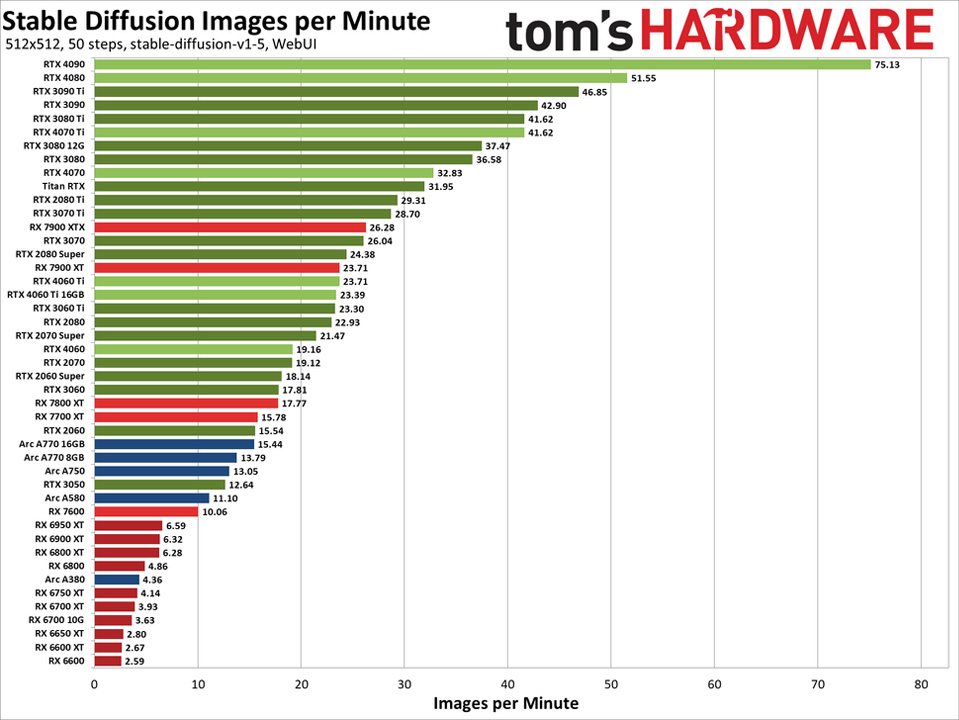
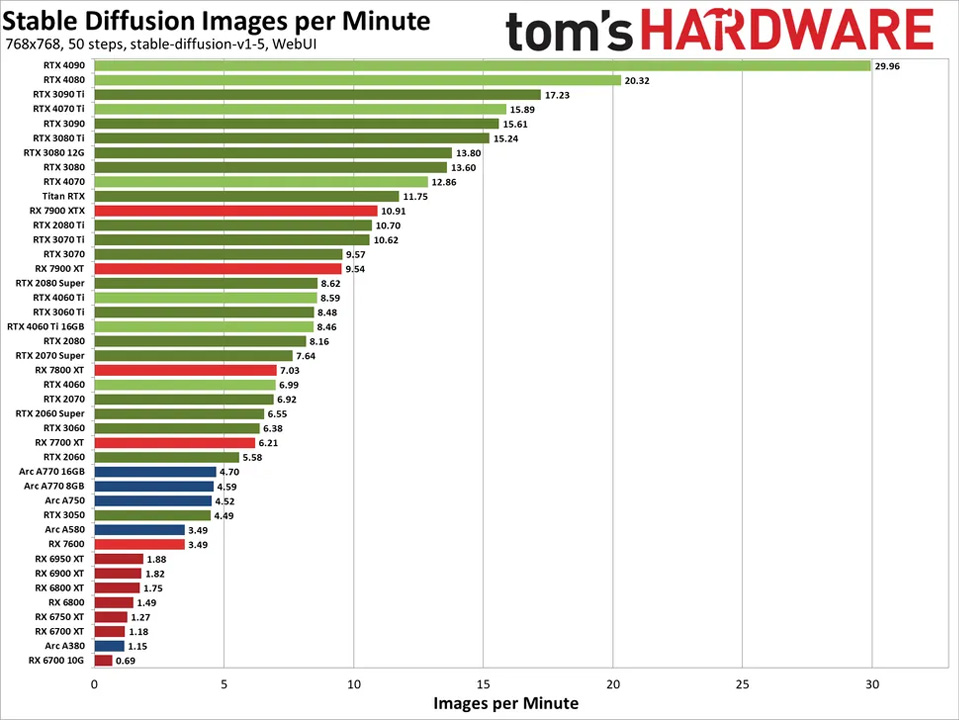
From two charts, you can see that NVIDIA GPUs clearly lead the field in performance. The RTX 4090 stands at the top with an impressive 75.13 images per minute, significantly outperforming the second-fastest, the RTX 4080, which clocks in at 51.55 images per minute. This gap highlights the RTX 4090’s dominant position for AI image generation tasks.
On the AMD side, the top performer is the RX 7900 XTX, producing 26.28 images per minute, which is notably behind its NVIDIA counterparts. Even the RX 7900 XT and RX 7800 XT trail behind, highlighting AMD’s less optimized performance in Stable Diffusion workloads.
Next. Intel Arc GPUs, while improving, still lag behind, making them less ideal unless price is the overriding factor.
Conclusion
In conclusion, the choice of GPU for running Stable Diffusion in 2025 largely depends on your specific needs, including the complexity of the models you’re working with and your budget constraints. NVIDIA GPUs dominate the market with their powerful architecture and advanced features, making them the go-to option for most AI and machine learning tasks. However, AMD’s offerings are also worth considering, especially for users looking for competitive alternatives. Ultimately, investing in a GPU with ample VRAM and robust computational capabilities will enhance your Stable Diffusion experience, enabling you to generate high-quality images efficiently.
iRender- The most powerful render farm speeding up Stable Diffusion Rendering
iRender provide to you high performance and configurable server system for 3D rendering, AI Training, VR & AR, simulation, etc. We believe that design and creative activities are private and personal that only you artists will know what you want with your animation. That’s the reason why we provide remote servers so that you can install any software you need, and do whatever you like with your project.
Our machine has preinstalled Stable Diffusion, therefore you don’t need to install it by yourself. You only need to connect to the machine and use normally as you do on your own computer.
We provide high-configuration servers that increase CPU and GPU rendering speeds. We offer the most powerful RTX 4090 configuration packages on the market, all equipped with AMD RyzenTM ThreadripperTM PRO 3955WX @ 3.9 – 4.2GHz and AMD Ryzen™ Threadripper™ PRO 5975WX @ 3.6 – 4.5GHz processors, 256GB RAM and 2T NVMe SSD hard drive capacity. With a wide range of GPU servers (1/2/4/6/8x) – RTX 4090, you can choose the server that suits your needs to start the training AI or modeling process.
Let’s see all the server’s configuration following:
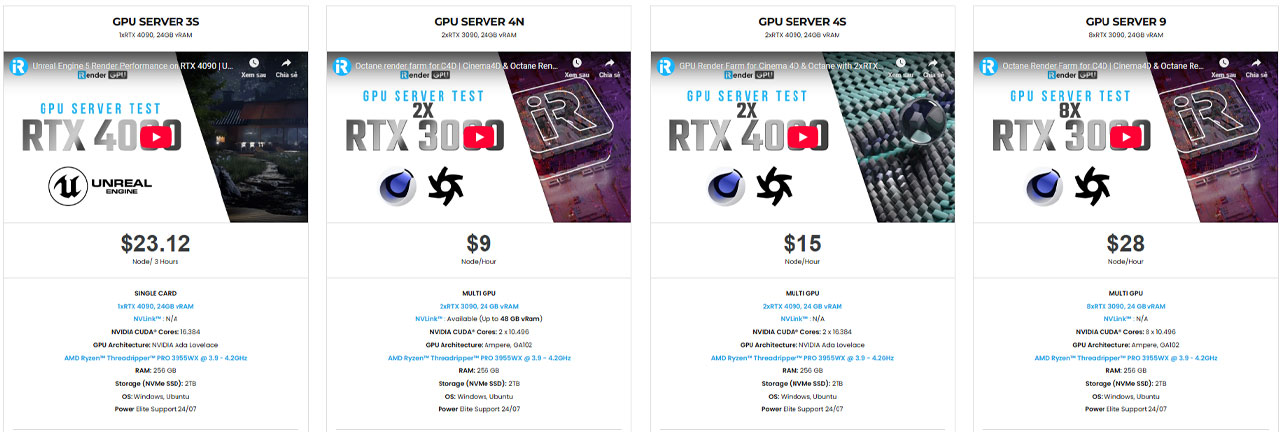
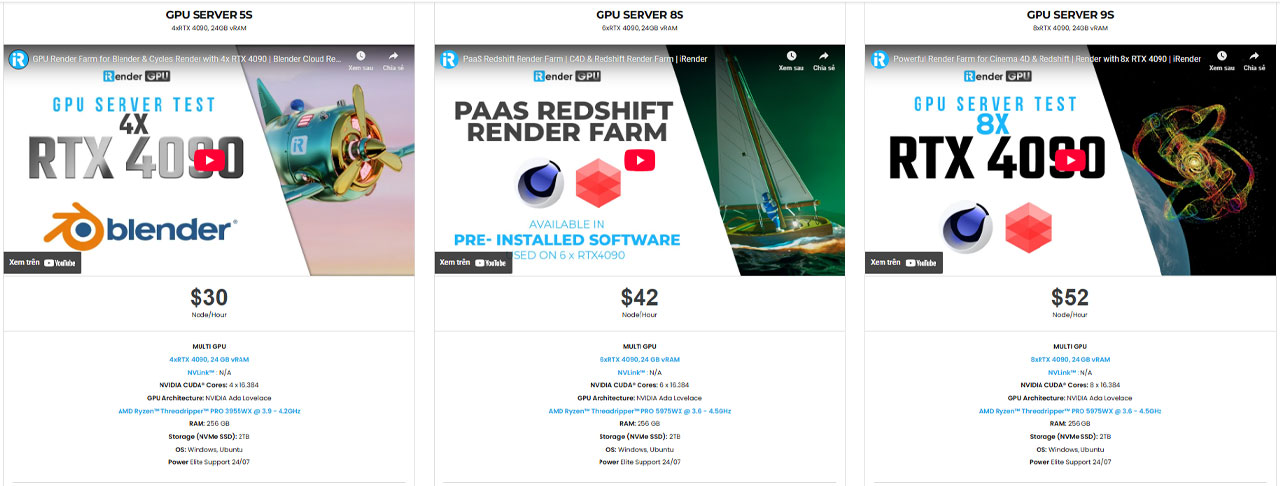
Let’s see the preinstalled Stable Diffusion video on our server:

Why choose iRender?
At iRender, we pride ourselves on providing unparalleled cloud rendering services designed to enhance your creative workflow. With our high-end GPU configurations, user-friendly interface, and dedicated support, it’s easier than ever to achieve stunning results.
- IaaS Infrastructure – Full Control & Customization
- GPU Power- RTX 4090/3090
- Outstanding Support
- Affordable Price
This month, we are running a SPECIAL OFFER: 100% Additional Bonus for new clients who register an account and make a top-up within 24 hours after their registration.
- 50% BONUS for all transactions from $575
- 100% BONUS for all transactions from $1500
- Extra for Prime Members: Get an additional 120% BONUS on any transaction from $575.

Happy Rendering!
Reference source: stablediffusionweb, tomshardware
Related Posts
The latest creative news from Cloud Computing for AI,